



How do I Keep My Smoked Product Consistent? 6 Areas to Check
If you've ever experienced uneven product coming out, the problem is often tied to a few common areas. Here’s where our team looks first. Read the ...

Ask any experienced meat processor what separates a great smoked product from a mediocre one and the answers will vary — smoke density, cook time, product load, seasoning. All of those factors matter. But the variable that ties them all together, and the one most operators underestimate until something goes wrong, is air exchange.
Air exchange — the rate at which your smokehouse circulates smoke and heat through the cabinet and around your product — is the single most important factor in the consistency, quality, and yield of everything you produce. Get it right and your product develops even color, deep smoke penetration, and consistent moisture retention from load to load. Get it wrong and you're chasing inconsistency, extending cycle times, and leaving yield — and profit — on the floor.
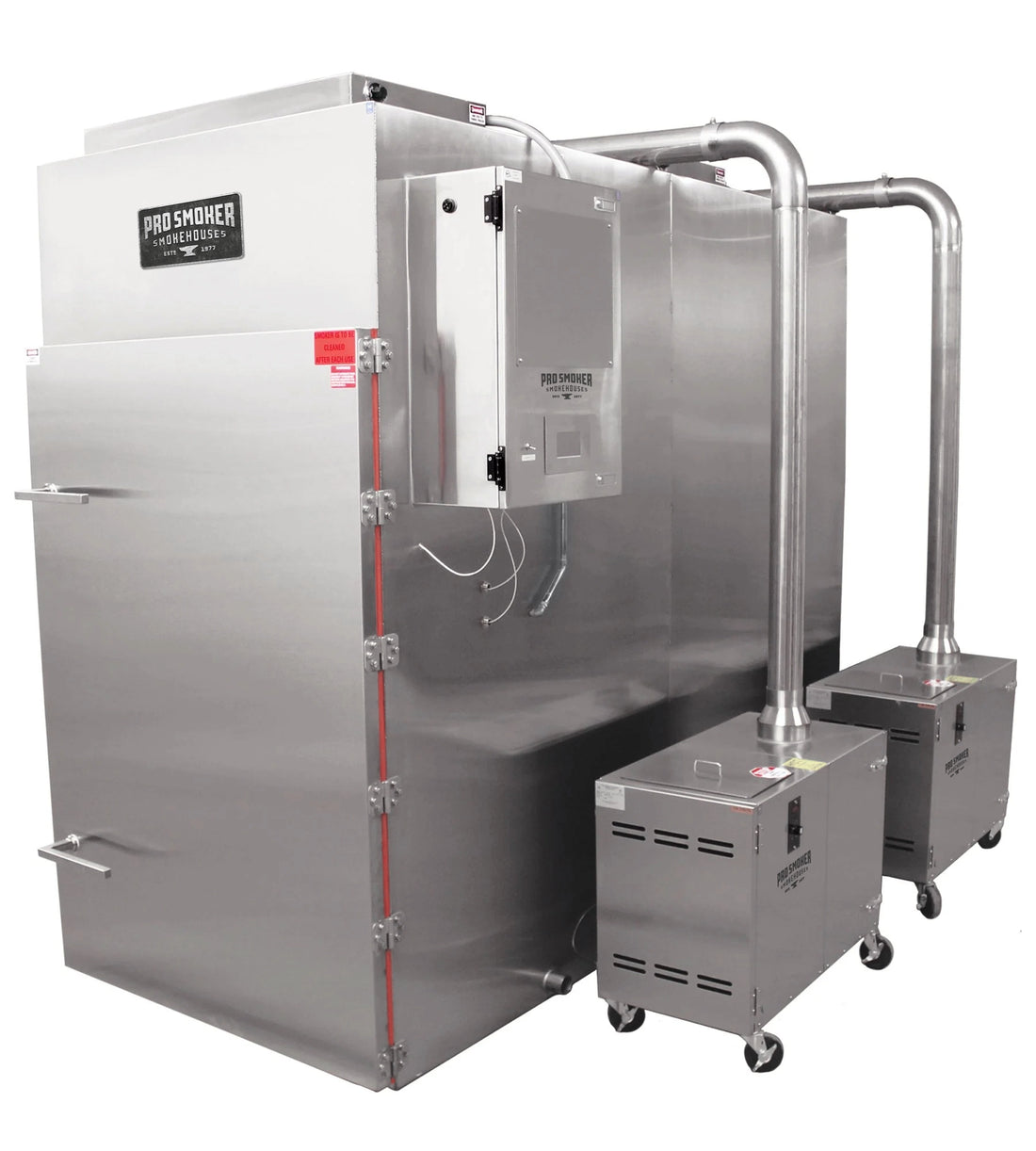
At Pro Smoker, we've spent nearly 50 years engineering smokehouses around this principle. Here's what every operator needs to understand about air exchange, what compromises it, and how to protect it.
Your smokehouse fan circulation system is responsible for moving conditioned smoke evenly through and around every piece of product in the load. When air exchange is optimized, smoke contacts product uniformly — regardless of where it sits in the cabinet — delivering consistent color development, flavor penetration, and moisture loss across the entire load.
When air exchange is compromised, the effects are immediate and measurable. Smoke distribution becomes uneven. Product on the perimeter of the load processes differently than product in the center. Drying and cooking times extend. Yields drop. And the inconsistency that results is exactly the kind of variability a professional operation can't absorb at scale.
The most common — and most preventable — cause of degraded air exchange in a commercial smokehouse is tar and creosote buildup. And it doesn't happen all at once. It accumulates gradually across every production cycle, quietly restricting airflow through dampers, plenum channels, and circulating fan assemblies until the performance loss becomes impossible to ignore.
Processors running sawdust and log smoke generators are particularly exposed to this risk. The combustion profile of these fuel types produces heavier tar compounds that deposit aggressively on interior surfaces. Left unmanaged, those deposits don't just restrict airflow — they create genuine risks, introduce off-flavors into the smoke environment, and force extended cleaning cycles that pull equipment out of production.
The maintenance cost implications are significant. Operations running systems with tar and creosote presence typically spend more than $7,000 per unit annually on labor and cleaning solutions to manage buildup. Operations running clean-smoking systems bring that figure closer to $1,000 — a difference that compounds directly into operating margin year over year.
Liquid smoke systems carry their own buildup considerations. While traditional creosote formation is less of a concern, residue accumulation around delivery nozzles and application points can restrict smoke distribution and compromise air exchange consistency if not managed on a regular cleaning schedule.
Even operators who understand the risk can fall behind. Automatic cleaning systems, which some manufacturers market as a low-maintenance solution, introduce their own reliability dependency. A single plugged nozzle in an automated system allows localized buildup to develop unchecked — and because the system appears to be functioning, the problem goes undetected until it has already affected performance.
Manual cleaning on high-buildup systems is labor-intensive and access-limited. The areas where creosote concentrates most heavily — deep in smoke ducts, around damper mechanisms, behind fan assemblies — are often the hardest to reach and the easiest to miss.
The result in either case is the same: reduced air exchange, extended processing times, compromised product quality, and accelerated wear on the components your operation depends on every production day.
Not all smoke is created equal — and fuel type has a direct impact on both smoke quality and the buildup risk that threatens air exchange over time.
Wood pellets are the lowest-emission solid-fuel burning product available for commercial smoke generation. Properly combusted, they produce a naturally dense, clean smoke that delivers deep color development and flavor penetration without the heavy tar compounds associated with sawdust and log systems. The result is a smoke environment that performs consistently cycle after cycle — and a smokehouse interior that stays dramatically cleaner between deep-clean intervals.
This isn't a marginal difference. It's the engineering principle that Pro Smoker's clean-smoking system is built around: maximize smoke density and air exchange performance while minimizing the buildup that degrades both over time. Fewer mechanical parts means less downtime. Cleaner combustion means less maintenance. Better air exchange means better product — every load, every cycle.
Whether you're assessing the performance of your current unit or evaluating a new smokehouse purchase, air exchange should be the lens through which every other factor is viewed. Here's what to examine:
Consistency is the standard a professional meat processing operation is built on. Your customers expect the same product every time. Your production schedule depends on predictable cycle times. Your margins depend on maximizing yield from every load.
All of that runs through air exchange — and air exchange runs through how well you understand, maintain, and protect it.
Pro Smoker's clean-smoking system is engineered to give operators the air exchange performance their product demands, with the maintenance profile their operation can sustain. If you want to see how the numbers compare across fuel types and cleaning costs, download our Fuel Comparison Chart — Wood Pellets vs. Sawdust for a side-by-side breakdown of cost, efficiency, and smoke quality.
Download the Fuel Comparison Chart
Questions about your current system or what to look for in a new one? The Pro Smoker team works directly with processors to evaluate system performance and maintenance costs — reach out to start the conversation.
